


Assessing health risks
What is a health risk?
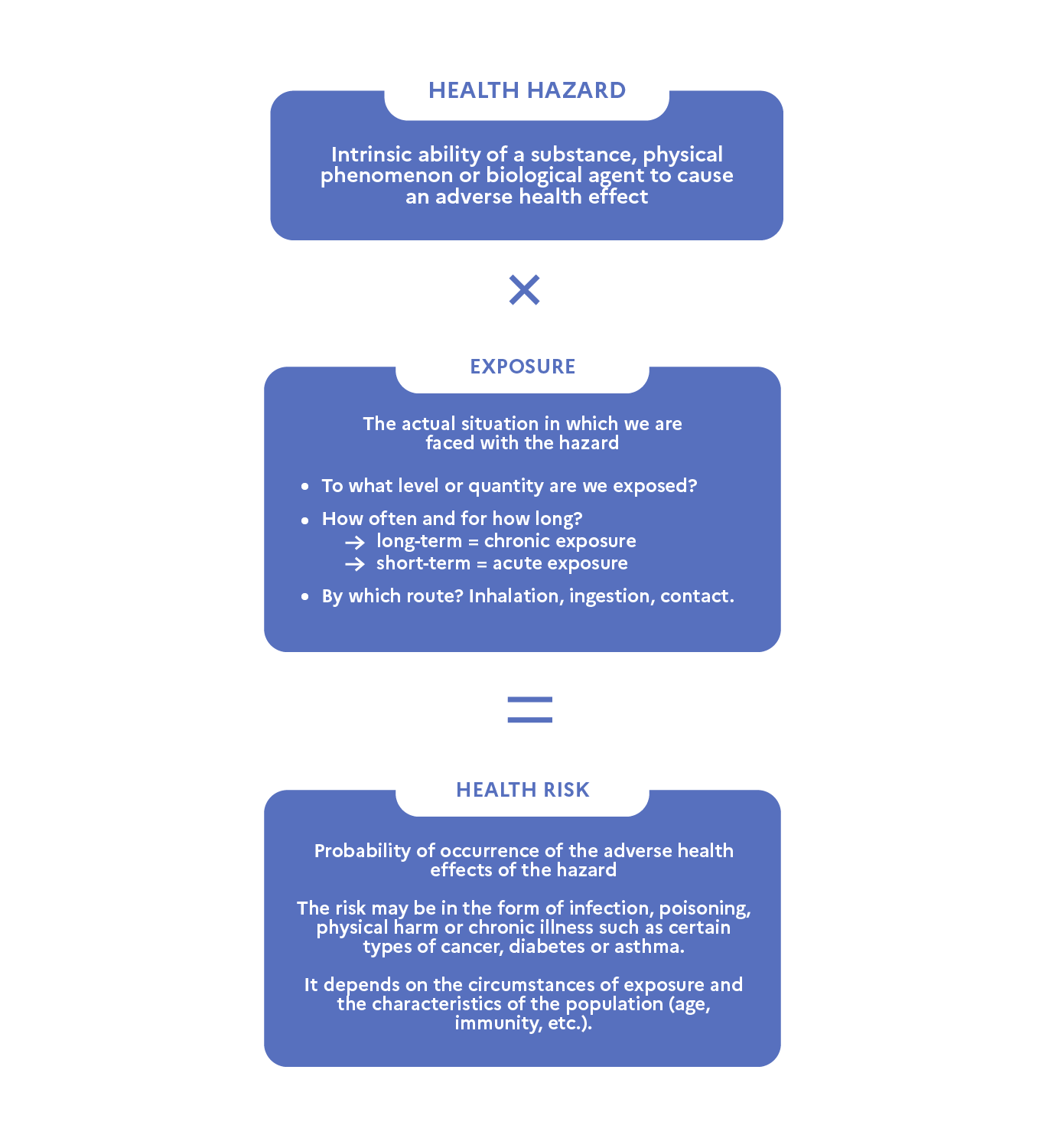
In everyday language, "risk" and "danger" are often used interchangeably when referring to a threat. However, these two words refer to two different concepts.
What risks are assessed by ANSES?
Whether they are in food, the environment, the workplace, animals or plants, ANSES studies the risks associated with:
- biological agents, for example, fungi, bacteria, viruses, parasites and prions, as well as mosquitoes or rats that can be vectors of pathogens for humans and animals;
- chemical agents: these include trace elements such as heavy metals, substances such as hydrocarbons, dioxins or biocides, medicines and plant protection products;
- physical agents, for example, ionising radiation, ultraviolet radiation, electromagnetic fields, noise, light and extreme temperatures;
- the nutritional quality of food and the imbalances between diet, physical activity and sleep;
- constraints in the workplace such as night work and irregular hours.
To take better account of the exposome concept, the Agency is involved in new approaches to assess cumulative exposure, either at a precise moment or over a period of time.
How does ANSES assess health risks?
ANSES conducts expert appraisals in response to requests from stakeholders seeking a scientific review of a health concern. These requests can come from the State, public institutions, nationally approved associations in ANSES's areas of activity, and professional and trade union organisations.
Some of its risk assessments are conducted as part of national plans (National Endocrine Disruptor Strategy, National Environmental Health Action Plan, National Nutrition & Health Plan, Occupational Health Plan, etc.) or European regulations (REACH, CLP, plant protection products, etc.).
The Agency may also investigate an issue on its own initiative when it suspects a potential risk to public health or the environment, or needs to examine a methodological issue in greater depth.
For all the assessments it conducts, the Agency applies the same scientific expert appraisal process. This is based on expert groups made up of scientists who are leaders in their field and who come from various organisations.
To ensure its quality and independence, ANSES's expert appraisals are:
- multidisciplinary: all the scientific skills needed to address the issue are brought together;
- collective: all the different points of view are expressed in order to form a conclusion;
- adversarial: the various evidence is debated in light of the scientific knowledge and related uncertainties.
Tout l’enjeu d’une expertise est de pouvoir analyser et croiser toutes les données publiées sur un sujet que ce soit dans les études scientifiques mais aussi celles issues d’enquêtes et d’auditions par exemple. L’Anses s’attache à développer des méthodologies pour identifier les données disponibles les plus pertinentes et mesurer le niveau d’incertitudes quant aux conclusions de ses travaux.
Intégrer l’analyse socio-économique dans l’évaluation de risques
L’exposition aux risques peut dépendre de divers facteurs socio-économiques, tout comme l’efficacité des mesures destinées à les prévenir. Pour tenir compte au mieux du contexte sociétal et de la réalité de usages et comportements, l’Anses peut pour certains sujets intégrer dans ses collectifs d’experts des disciplines relevant des sciences humaines et sociales - sociologie, science politique, économie, histoire, droit, philosophie, etc. Afin de renforcer son expertise en la matière, l’Agence a mis en place un comité d’experts spécialisé dédié à l’analyse socio-économique fin 2021.
En savoir plus sur l’analyse socio-économique dans l’évaluation de risques.
Date de mise en ligne
Date de mise en ligne
Date de mise en ligne
Date de mise en ligne