



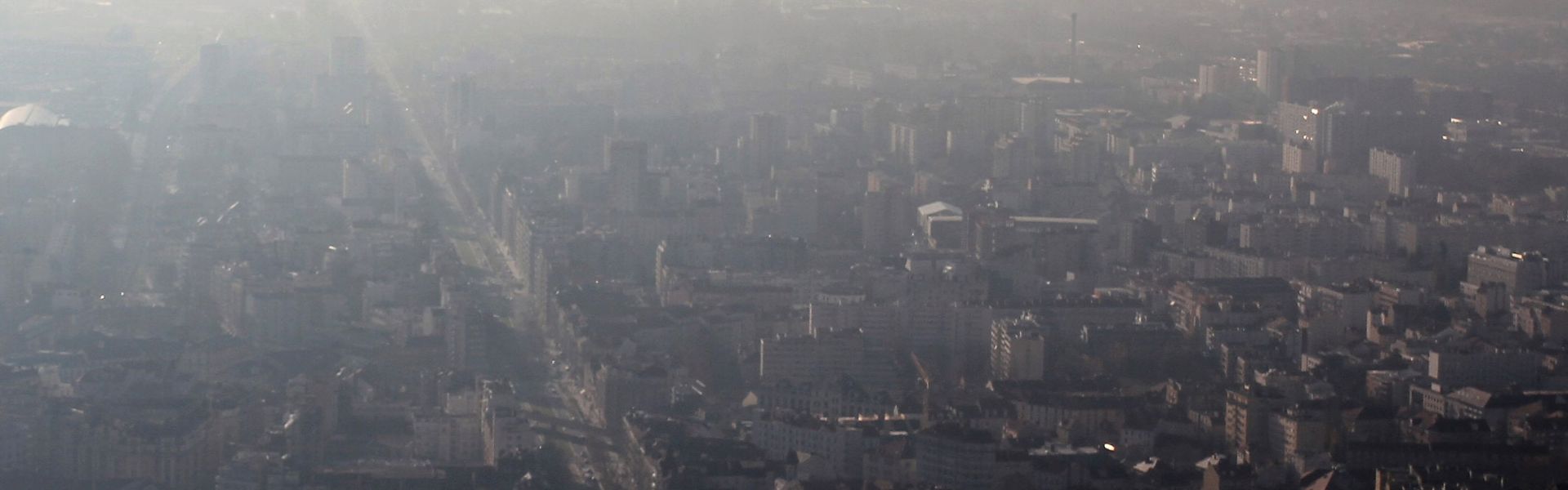
Air pollution – new insights into ambient air particulate matter and the impact of road traffic
The expert appraisal work carried out by ANSES in the context of air pollution control assessed the health effects of particulate matter, which vary according to particle compounds, sources and size. In addition, considering that road traffic is a major source of particulate matter in urban areas, the Agency studied the impact of road traffic on air pollution and examined several scenarios with regard to advances in automotive technology in France (i.e. engine types, pollution control systems).
Stronger or new evidence on health effects due to particle compounds, sources and size
ANSES carried out a systematic review of the epidemiological and toxicological literature to update the knowledge available and evaluate the strength of evidence linking different adverse health effects to exposure to ambient air particulate matter, which varies according to particle constituents, sources and size. Evidence was evaluated using a five-level rating system from “no effect” to “high”. Since the publication in 2013 of the World Health Organization's Review of evidence on health aspects of air pollution, 160 studies on 20 compounds, 16 sources and 83 physiological changes or health effects were analysed and integrated using a weight-of-evidence approach.
Particle compounds and size in ambient air:
- the levels of evidence on adverse health effects are highest for black carbon, organic carbon and ultrafine (nanoscale) particles. Data collected since 2013 confirm or strengthen the link between these substances and respiratory and cardiovascular diseases, and premature death;
- with regard to neurological and perinatal health, the body of studies on this subject is still insufficient. The levels of new evidence are low and suggest that black carbon and ultrafine particles may have an effect on the development of cognitive function in children, and that there may be a link between black carbon exposure and low birth weight;
- moderate to strong new evidence of adverse effects on respiratory and cardiovascular health and a link to premature death were identified for some particle compounds – mainly secondary inorganic aerosols (including ammonium, sulphate, and nitrate) and also transition metals (iron, zinc, nickel, copper and vanadium), silica and endotoxins.
Sources of ambient air particulate matter:
- there is strong evidence of the adverse health effects associated with exposure to emissions from road traffic. Data collected since 2013 on black carbon, PM2.5 particles, road dust and diesel exhaust particles confirm or strengthen the link with respiratory and cardiovascular diseases and premature death. For neurological and perinatal health, there is a moderate level of new evidence which suggests an effect of PM2.5 particles from road traffic;
- new publications confirm the health effects of ambient air particles from the burning of coal, petroleum products and biomass;
- new data confirm the health effect of desert dust, particularly on the respiratory health of children, based on a small body of studies which nonetheless have a high confidence level.
On the basis of these conclusions, ANSES recommends that three currently unregulated particulate indicators be prioritised – ultrafine particles, black carbon and organic carbon – through policy action to address air pollution, in addition to the PM2.5 and PM10 indicators in current guidelines.
The Agency also recommends that national and international efforts to reduce ambient air pollution be continued by addressing the main controllable sources of emissions (road traffic, the burning of coal, petroleum products and biomass), as well as by reducing exposure to desert dust.
In addition, ANSES stresses the need to pursue research efforts on the health effects of exposure to other sources of particulate matter such as agriculture, maritime transport and airport activity, for which very few data are available at present.
Efforts should be expanded to accommodate advances in automotive technology
ANSES studied several scenarios with regard to potential evolutions, by 2025, in emissions and concentrations of particulate matter and gases in ambient air from road traffic in dense urban areas[1] in metropolitan France. This was done by varying the proportion of advances in automotive technology with regard to the fleet in circulation. For example, it assumed particulate filters would become mainstream, that there would be a decline in diesel engines, etc. This unique study[2] was based on simulations from 2014 onwards and assumed the same volume of traffic across all scenarios but one, and identical emissions from other sources.
This study revealed a favourable trend in ambient air quality for all the automotive technology scenarios examined. The simulations showed a decrease in average annual pollutant concentrations. This reduction was significant for traffic pollutants such as black carbon (-30% in dense urban areas) and nitrogen dioxide, but smaller for the total mass and the organic and inorganic fractions of PM2.5 and PM10 particles from various other sources and transformation processes in the atmosphere. WHO guidelines for long-term exposure to PM2.5 were nonetheless exceeded in almost all the regions studied.
In densely populated urban areas, the differences in impact on atmospheric concentrations between the prospective scenario simulating the generalisation of diesel particulate filters in a renewed diesel fleet, and the scenario simulating a decline in light diesel vehicles in favour of petrol vehicles, appeared quite low compared to the greater impact of an overall fleet renewal between 2014 and 2025.
An additional ambitious scenario combining the promotion of electric vehicles in urban areas and a reduction in road traffic led to even greater local emission reductions in urban and more densely populated areas. This scenario would lead to at least a 30% reduction in annual black carbon and PM2.5 emissions from traffic.
Lastly, the study brought other issues to the fore:
- Besides exhaust particulate emissions, the challenge is also to reduce organic and inorganic gas emissions from traffic and other emitting sectors, as these contribute to the formation of secondary particles in the atmosphere;
- Non-exhaust emissions due to tyre and break wear, for example, and to re-suspended particles, should also be considered, particularly given their increasing contribution to the mass of particles in the air.
Therefore, in addition to advances in automotive technology, ANSES insists on the need to promote alternative technologies that drastically reduce pollutant emissions, including electromobility solutions, and most importantly, to reduce traffic, as part of policy initiatives to address air pollution. Traffic reduction should be encouraged through measures such as an expanded public transport offer, active transport options (e.g. walking, cycling), and intermodality (the use of various means of transport for a single journey, including cars, public transport, active transport, etc.).
[1] The main densely populated urban area considered was the Île-de-France region.
[2] Conducted in collaboration with the Air Quality Monitoring Network (AIRPARIF), the Atmospheric Environment Education and Research Centre (CEREA), the Interprofessional Technical Centre for Studies on Air Pollution (CITEPA) and the French Institute of Science and Technology for Transport, Development and Networks (IFSTTAR)