



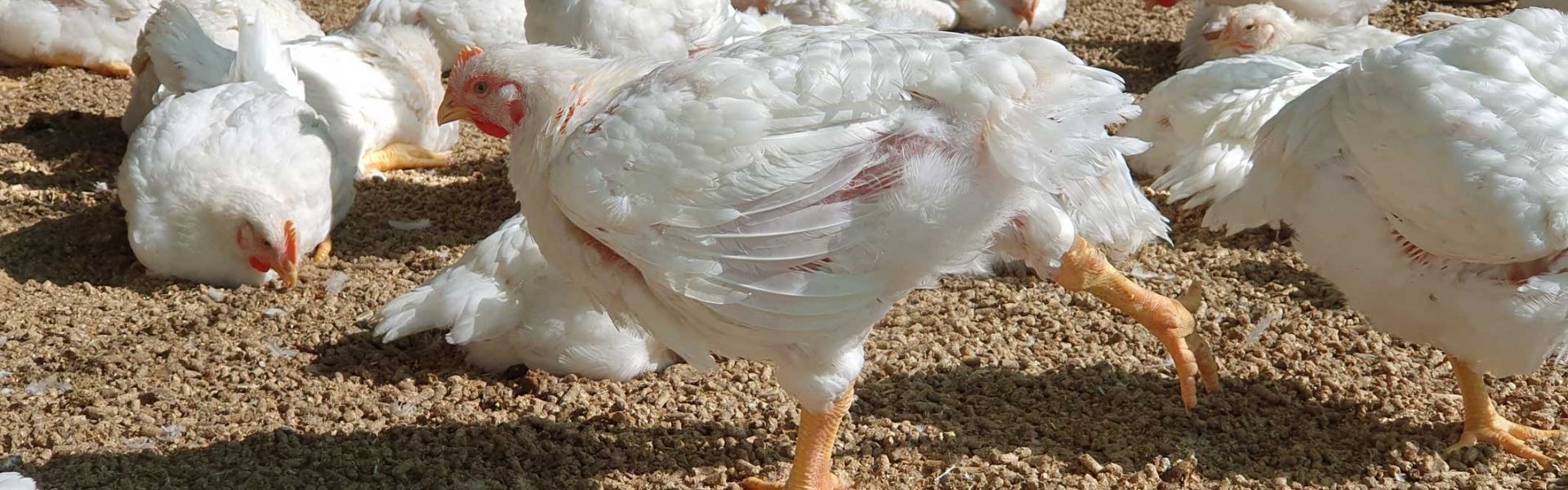
Covered verandas for chicken welfare
Covered verandas (also known as winter gardens) are semi-open spaces adjacent to livestock buildings that allow poultry to enjoy outdoor air and natural light while being protected from predators and pathogens transmitted by wildlife. These facilities, which have already been adopted by some farmers, are attracting growing interest due to their potential to improve animal welfare. For the first time, a study conducted by ANSES under experimental conditions has scientifically evaluated their effects. The results, published in the journal Poultry Science, show that covered verandas can have significant beneficial effects on the health and welfare of broiler chickens.
An experimental design to compare farming conditions
The study was carried out by the Epidemiology, Health and Welfare Unit (EPISABE) of ANSES’s Ploufragan-Plouzané-Niort Laboratory, in collaboration with the Department for Breeding and Experimentation in Poultry and Rabbits. All the animals were housed in ‘enriched’ indoor rooms, i.e. rooms exposed to natural light and equipped with elevated platforms and bales of alfalfa. Each room contained 2478 chickens per 162 m². Half of the groups also had access to a 72 m² covered veranda.
“This protocol enabled us to compare groups of chickens subject to identical conditions, except that some had access to the covered veranda while others did not”, explains Frédérique Mocz, research project leader focusing on animal welfare at ANSES’s Ploufragan-Plouzané-Niort Laboratory and lead author of the study.
More active chickens less prone to skin problems
Observation showed that the chickens with access to a covered veranda were significantly more active: they walked and ran more and spent less time lying down.
This increased activity had a direct impact in the form of a marked reduction in hock burns, which are skin problems that can occur when an animal remains immobile for too long in contact with litter. No significant cases were observed in the chickens with access to a covered veranda, while the rate of moderate cases in the control group was 15.3%.
On the other hand, no differences were observed in body weight, feed or water consumption or mortality.
An effect beyond the increase in available space
While covered verandas increase the space available to animals, the study’s researchers believe that the positive effects cannot be explained solely by the lower animal density. “The density in the indoor rooms was already relatively low compared to traditional farms. Technically, we refer to ‘stocking density’, which is the mass of chickens per square metre. In our rooms, this was 26 kg/m², whereas on conventional farms it can be as high as 42 kg/m²” affirms Mocz. “We think that the effects observed were related to access to a semi-open environment, which provided the animals with additional sensory stimulation”.
Among the favourable factors identified, exposure to outdoor air, variations in temperature, sunlight and litter type, and even odours, contributed to enriching the animals’ environment. Observation also showed that the chickens tended to use the covered verandas more in the late morning, when these spaces were exposed to the sun.
A step forward for animal welfare
The researchers underline that allowing animals to choose whether or not to access the covered veranda could also positively impact their welfare, although this hypothesis remains to be confirmed. “Building a covered veranda is a significant investment for farmers, but our study demonstrates that such verandas have benefits for the welfare of chickens, allowing them to express natural behaviours more often and preserving their health without reducing productivity. These results will need to be confirmed in non-experimental conditions” concludes Mocz.
This study was conducted as part of the Cocorico (Co-design, Competitiveness, Research & Innovation for Consumers) project entitled “Co-constructing a chicken farming system that reconciles price and societal expectations”, which was coordinated by the French Poultry Technical Institute (ITAVI) and funded by the Special Fund for Agricultural and Rural Development (CASDAR) and the European Reference Centre for Animal Welfare for Poultry and other small farmed animals. The project ran from 2021 to 2024.