



Pine blister rust outbreak traced to peonies
Pine blister rust is a disease caused by a fungus that sporadically affects several pine tree species in France, particularly maritime pine and Scots pine. In 2019, an outbreak of unprecedented scale occurred in the Landes forest. To identify its origin, the French Ministry of Agriculture’s Forest Health Department called on ANSES's Plant Health Laboratory.
Two different plant hosts
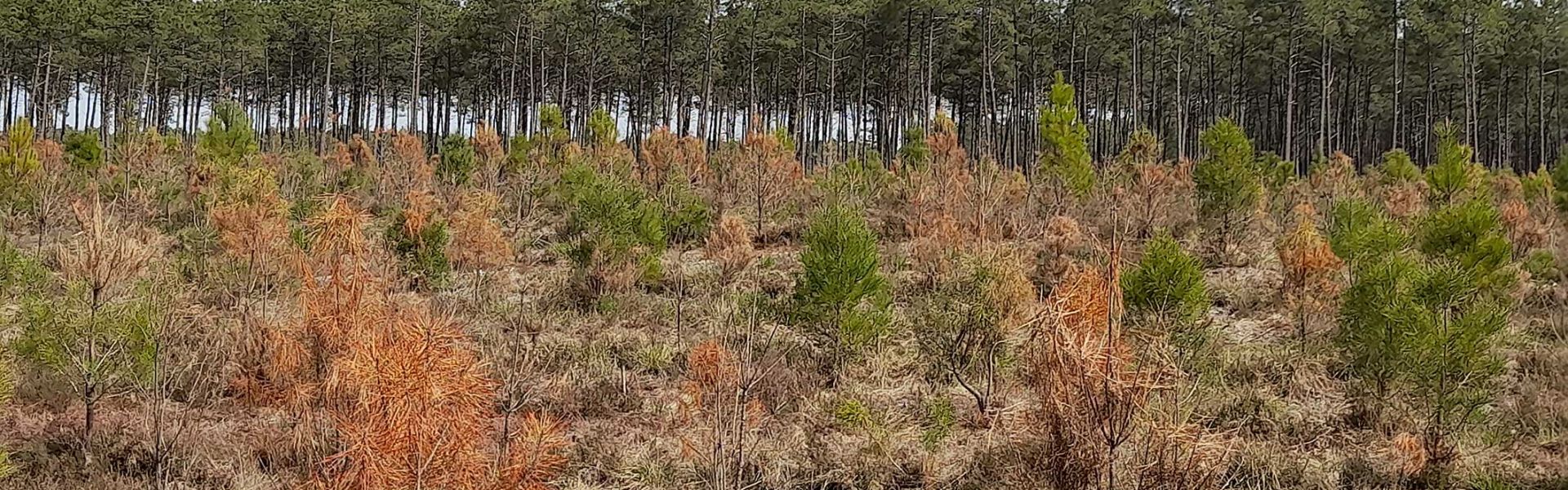
Pine blister rust causes orange pustules to erupt on the affected trees, whose needles turn rusty brown. Mortality occurs in some cases, with young trees being particularly at risk. The 2019 outbreak involved 800 hectares of maritime pine trees, causing significant economic losses.
A link was quickly suspected with a field of peonies that had been planted among the pine trees a few years earlier. “The fungus Cronartium pini, which causes the disease, usually infects two host species successively during its lifetime” explains Renaud Ioos, head of the Mycology Unit at the Plant Health Laboratory. “We know that many species can serve as the first host, including peonies. This first host allows the fungus to reproduce sexually, after which it infects a second host, i.e. the pine trees damaged in this outbreak”.
ANSES analysed several samples taken from the pine trees and peonies by the Forest Health Department. It first needed to confirm that the responsible pathogen was indeed Cronartium pini. This was because other fungi that cause similar symptoms are classified as quarantine pests, i.e. pests that are absent from the country and are subject to an official control plan if detected.
Genetically identical fungi
The scientists then compared the genomes of the fungi found on the peonies and those infecting the pine trees. Six hundred and thirty samples were analysed over a three-year period. The fungal populations collected from the peonies and nearby pine trees were genetically identical. However, they differed from those taken from pine trees in other départements. Furthermore, the frequency of infected trees and their mortality rate, which were very high within an eight-kilometre radius of the peony field, then decreased further away, confirming the decisive role of these flowers in the onset of the disease.
The scientists also verified that the main form of the fungus found could not be transmitted directly between pine trees, as there is a rarer form that does not need an alternative host to spread.
All these findings confirmed that the outbreak had been triggered by the planting of the peonies. Following discussions with the farmers, the peonies were completely removed in 2023. Since then, the incidence of the disease has declined and no cases have been reported in 2025. “The fungus will always be present in the environment because many herbaceous plants in nature can serve as hosts” concludes Renaud Ioos, “but as these are less abundant than the peonies in question, the impact on pine trees is now limited”.
Photo crédits: Emmanuel Kersaudy, DSF