



Two ANSES doctoral students recognised for the excellence of their scientific presentations

Antinéa Sallen, winner of the award for the best oral presentation
What is your background?
After completing a preparatory course in Biology, Chemistry, Physics and Earth Sciences, I enrolled at the Agro Rennes engineering school, where I specialised in plant and environmental protection. I’m currently in the final year of my PhD. My thesis’s co-supervisors are Inov3PT – the research division of the French Federation of Seed Potato Producers – and the Bacteriology, Virology and GMO Unit of ANSES’s Plant Health Laboratory.
What is the goal of your thesis?
I’m working on Ralstonia solanacearum, a pathogenic bacterium responsible for diseases in multiple plants of economic interest, such as tomatoes and potatoes, but also aubergines and sweet peppers. Ralstonia solanacearum is a quarantine bacterium, which means that measures are taken to prevent it from entering the country. It’s been present in France since the 1990s and remains under surveillance.
Ever since it was introduced, samples have been taken every year for monitoring and research purposes. More than 300 strains have been collected in France over the past 30 years or so, but their genetic diversity had not yet been studied. My thesis specifically studies the genetic and genomic diversity of the bacterium in France and around the world, assesses the pathogenicity of the different strains and traces its routes of invasion all the way to France. We’ve assessed its pathogenicity for potatoes under current as well as subtropical conditions, in order to anticipate the effects of global warming. This knowledge will allow us to better help the sectors affected by this bacterium. Knowing whether it’s evolving rapidly or whether certain strains are particularly virulent will enable control strategies to be adapted. Gaining a better understanding of the genetics of this bacterium will help us to develop faster and more effective detection tools. Lastly, determining how it arrived in France despite the control measures in place will enable us to identify possible ways of strengthening these measures.
What results have you achieved?
We’ve developed a rapid genetic typing scheme based on the multiple loci VNTR analysis (MLVA) method, which allows the strains to be quickly classified into genetic groups. This tool can be used by testing laboratories to achieve rapid results. Genetic analysis has found that the French strains aren’t very diverse.
The genomic sequencing data for certain strains are still being analysed, but the initial results have already enabled us to date the main waves of diversification of the bacterium. The first differentiation, between South American strains and those found in the rest of the world, took place around the 15th century, coinciding with the first transatlantic exchanges. The second major diversification of strains dates back to the late 19th to early 20th century. This was following on from the industrial revolution and the intensification of international trade. The bacterium was likely transported with plants, leading to the emergence of new genetic groups. We’re still studying the pathogenicity of the different strains.
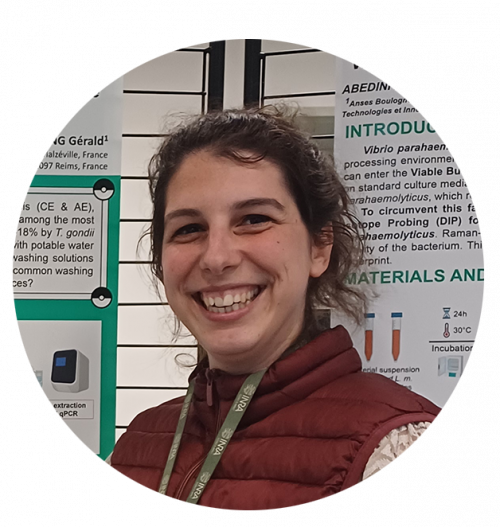
Roxanne Barosi, winner of the award for the best scientific poster
What is your background?
I have a Bachelor’s degree in Ecology and Organismal Biology and a Master’s degree in the Emergence of Parasitic and Infectious Diseases, both from the University of Montpellier 2. After some work experience in the field of animal and plant health, I started a thesis co-supervised by ANSES’s Nancy Laboratory for Rabies and Wildlife, which is the National Reference Laboratory for Echinococcus spp., and the National Reference Centre for toxoplasmosis, which is based at the University of Reims-Champagne-Ardenne.
What is the main goal of your thesis?
My thesis seeks to understand how parasites like Echinococcus spp. and Toxoplasma gondii, which respectively cause alveolar and cystic echinococcosis and toxoplasmosis, can be transmitted to humans through food, in particular via lettuces and berries.
According to the WHO, echinococcosis and toxoplasmosis are classified among the top four foodborne parasitic diseases in the world. The parasites that cause them have similar cycles: they involve domestic and wild carnivores that spread the free forms of these parasites (eggs or oocysts) into the environment via their faeces. The eggs or oocysts then contaminate soil, water and certain foods, including lettuces and berries. These parasites pose a major risk, especially for pregnant women and immunocompromised individuals.
The objectives of my thesis are fourfold:
- Understand how the free stages of the two parasites spread throughout a vegetable garden from contaminated faeces, and determine what factors are involved,
- Evaluate the effectiveness of home and industrial washing methods at removing the free stages of the parasites from lettuces,
- Compare methods in order to standardise the detection of parasites in food,
- Assess tools for determining the viability of Echinococcus eggs isolated from food.
What results have you obtained so far?
We’ve demonstrated that washing food at home reduces the number of parasites but doesn’t always completely eliminate them. Among the methods (soaking or rinsing) and solutions (water, white vinegar and commercial food disinfectant) tested, washing with water appears to be the most effective. We’ve therefore identified a simple means of preventing parasites on food. Similar data were already available for bacteria and viruses, but not for these major foodborne parasites.
Experiments conducted under natural conditions showed that eggs and oocysts were dispersed in multiple directions from contaminated faeces over most of the soil in the vegetable gardens within a period of 30 days. However, the proportion of contaminated lettuces in the vegetable gardens was low and the parasite loads were very low, despite the lettuces being no more than 90 cm from the faeces.
With regard to Echinococcus spp., we compared two methods of detecting and quantifying the eggs: stereo-microscopy and molecular biology. We found that the detection rate using stereo-microscopy was much lower than when using molecular biology, especially when there were only one to five eggs, as is overwhelmingly the case on plants. This direct observation of eggs therefore leads to an underestimation of the rate of food contamination, and also of the number of eggs in contaminated samples, showing that molecular techniques should be favoured in this context.
Other areas of research are still ongoing, including the development of in vitro tools to estimate the viability rate of Echinococcus eggs in food, which is a crucial piece of data for food risk assessment that has never been measured to date.