




Plant Health Laboratory
Director: Philippe Reignault
Deputy Director: -
Address of the laboratory’s management: 7, rue Jean Dixméras 49044 Angers Cedex 01
E-mail: lsv@anses.fr
Six geographical sites: Angers, Clermont-Ferrand, Montpellier, Nancy, Rennes, Saint-Pierre (Reunion Island)
Number of employees: 100, spread across eight units

The laboratory's missions
The Plant Health Laboratory (LSV) is tasked with the identification of biological risks to plant health, the detection of genetically modified organisms, and the determination of beneficial insects (which help protect plants) and insect vectors of disease. It also quarantines plants introduced under import regulation waivers and assesses the risks. Its missions cover cultivated land, forests, natural environments and ornamental plants.
The LSV is the National Reference Laboratory (NRL) for organisms harmful to plant health (i.e. plant pests). In addition, three of its units are European Union Reference Laboratories (EURLs): for fungi and oomycetes, insects and mites, and nematodes. It is also involved in the quarantine of imported plants and plants introduced under import regulation waivers, and coordinates assessments of biological risks to plant health. The LSV takes part in numerous national and international collaborative research and development projects. It is also actively involved in the work of the epidemiological surveillance platform for plant health (ESV platform). The laboratory makes its data available to the platform as needed and provides it with scientific support in analytical fields.
The laboratory is regularly asked to carry out work and expert appraisals at national (formal requests and requests for scientific and technical support from the ministries responsible for agriculture and the environment) and international (European and Mediterranean Plant Protection Organization, European Food Safety Authority, International Plant Protection Convention, etc.) levels.
A laboratory with several sites
The laboratory is spread out across six geographical sites:
- Angers, home to the laboratory's headquarters and where it coordinates reference activities, detection of bacteria, viruses and GMOs, and expert appraisals relating to biological risks;
- Clermont-Ferrand, which hosts activities relating to "post-entry" quarantine in France;
- Montpellier, specialising in insects (pests, beneficial insects and vectors) and invasive plants;
- Nancy, in charge of fungi and oomycetes;
- Rennes, focusing on nematodes, which are microscopic worms that can destroy crops;
- Saint-Pierre on Reunion Island, specialising in tropical viral and bacterial pathogens.
Find out more about the Laboratory
Read the leaflet (PDF)
Latest laboratory news
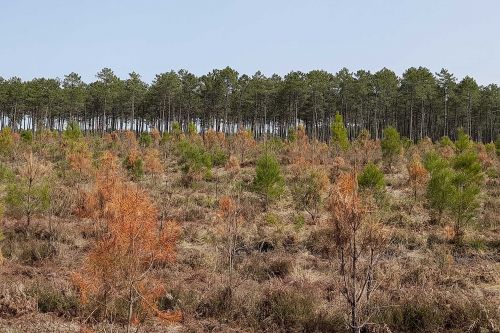
Pine blister rust outbreak traced to peonies
Pine blister rust outbreak traced to peonies The transmission of pathogens between plant species can have major health and economic consequences. This is why ANSES intervened in a blister rust outbreak, detected in pine trees in the Landes département of France, confirming that it was linked to peonies grown nearby. Measures were taken in consultation with the farmers to protect the newly planted pine trees.
The laboratory's units
Expert appraisal unit
- Expert Assessment of Biological Risks (ERB) unit (Angers site)
Thematic and technical units
- Bacteriology, Virology & GMO Detection (BVO) unit (Angers site)
- Entomology and Botany unit (Montpellier site)
- Mycology unit (INRAE LSV-Mycology contracted unit, Nancy site)
- Nematology unit (Rennes site)
- Quarantine unit (Clermont-Ferrand site)
- Tropical Pests and Pathogens (RAPT) unit (Saint-Pierre, Reunion Island site)
Partnerships
National partners
- ACTA (Association for the Coordination of Agricultural Methods)
- AgriBio union
- Agro ParisTech
- CIRAD (French Agricultural Research Centre for International Development)
- CTIFL (Interprofessional Technical Centre for Fruit and Vegetables)
- FNAMS (French Federation of Seed Reproducers)
- FN3PT/Inov3PT (French Federation of Seed Potato Producers)
- FREDON France
- IFVV (French Institute of Vine and Wine)
- IGN (National Institute of Geographic and Forest Information)
- INRAE (French National Research Institute for Agriculture, Food and the Environment)
- Institut Agro (France)
- ONF (National Forestry Office)
- University of Angers
- University of Reunion Island
- University of Lorraine
International partners
- AGES (Austrian Agency for Health and Food Safety)
- University of California, Berkeley (United States)
- CREA (Council for Agricultural Research and Economics, Italy)
- CNR (National Research Council, Italy, Bari site)
- CSIC (Spanish National Research Council)
- DSMZ (German Collection of Microorganisms and Cell Cultures)
- EFSA (European Food Safety Authority)
- ILVO (Flanders Research Institute for Agriculture, Fisheries and Food, Belgium)
- IVIA (Valencian Institute of Agrarian Research, Spain)
- JKI (Julius Kühn-Institut, Germany)
- NARO (National Agricultural Research Organisation, Japan)
- NIB (National Institute of Biology, Slovenia)
- New Zealand Institute for Plant and Food Research (New Zealand)
- UNIMORE (University of Modena and Reggio Emilia, Italy)
- University of Liège – Gembloux Agro-Bio Tech (Belgium)
- WUR (Wageningen University & Research, Netherlands)