



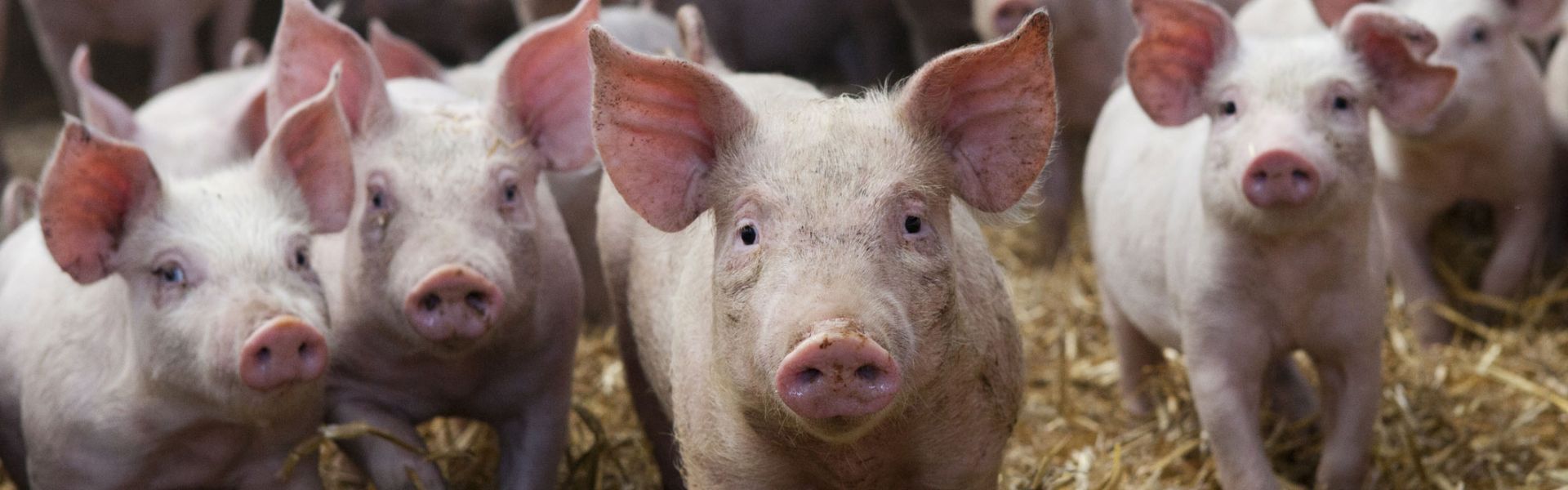
Swine flu: a challenge for livestock and human health
ANSES’s activities dealing with swine influenza viruses
Like all flu (or influenza) viruses, those causing the flu in pigs are constantly changing. Pigs can be infected with swine influenza as well as human and avian influenza viruses. They can therefore become intermediate hosts for the transmission of avian influenza viruses to humans and act as a “melting pot” for the emergence of new reassortant viruses as a result of co-infection (reassortant viruses have genes from influenza viruses of different origins). Thus, many different strains have been isolated over the years through surveillance activities conducted on pig farms. Overall, there are three circulating subtypes (H1N1, H3N2 and H1N2) of influenza viruses in the pig population, but multiple genetic lineages (or genotypes) can be identified within each of these subtypes, depending on the origin of each viral gene.
Monitoring swine health to anticipate human pandemics
Swine influenza A viruses (swIAVs) have zoonotic potential and can therefore be transmitted to humans. In 2009, the H1N1pdm09 virus, which caused a human pandemic, was derived from the reassortment of several swIAVs. Its emergence highlighted the need to monitor and study flu viruses in swine, in terms of their effects on both animal and human health. This virus then spread to numerous pig populations worldwide after 2009. Through co-infections with other swIAVs, the H1N1pdm09 virus led to the emergence of new reassortant viruses, some of which also spread through certain pig populations. Some of these were responsible for cases of human infection.
ANSES: reference laboratory for swine flu
The Agency’s Ploufragan-Plouzané-Niort Laboratory has been the National Reference Laboratory for swine influenza (SI NRL) since August 2009. This NRL is hosted by the Swine Virology and Immunology (VIP) unit. As such, the VIP unit develops, validates and monitors diagnostic tools for the detection and identification of influenza A virus subtypes and lineages in swine. It leads the network of official veterinary laboratories performing the molecular diagnosis of these infections. Among other things, it organises inter-laboratory tests to verify the maintenance of their proficiency. It supplies reference reagents (enabling viruses or antibodies to these viruses to be detected) and provides technical support for the more in-depth characterisation of the identified viruses.
Active surveillance of the viral strains found in France
Although it has major economic and health effects in the swine sector and can affect humans, swine flu is not a regulated disease and there are few structured, permanent surveillance systems. Knowledge of circulating viruses differs from country to country and is often scarce or incomplete. In France, the Swine Virology and Immunology (VIP/SI NRL) and Epidemiology, Health and Welfare (EPISABE) units of the Ploufragan-Plouzané-Niort Laboratory have been actively involved in the surveillance of swine influenza viruses since 2005. They stepped up their efforts in this area in 2011, with the creation of the “Resavip” national surveillance network. The surveillance activities undertaken by this network enable it to describe the genetic diversity and geographic distribution of swine influenza viruses.
Furthermore, ANSES develops or contributes to specific surveillance programmes, on certain farms and in certain regions, depending on the particular epidemiological context. Ad hoc surveys are conducted for wild boars. Prospective studies also focus on influenza B, C and D viruses, which are much less pathogenic and less common in swine than influenza A viruses.
Activities with international reach
The Agency is represented within the OFFLU international network; this joint OIE/FAO network for animal influenza viruses promotes exchanges on circulating viruses beyond Europe’s borders. More specifically, the VIP unit is an active member of this network’s Swine Influenza Virus technical group. The findings exchanged enable the World Health Organization (WHO) to be informed of emerging swine influenza viruses that may pose pandemic risks. The aim is to select strains for the development of new vaccines when necessary.
Research activities to better understand the virus, its transmission factors and its effects on swine
The Agency is conducting multiple research projects on swine flu:
Monitoring genetic and antigenic changes in swine influenza viruses
The viruses identified in France through epidemiological surveillance are covered by extensive studies dealing with their genes and antigens (antigens are viral molecules recognised by an infected animal’s immune system). These studies aim to improve knowledge on changes in swIAVs in France, their diversity, and the situations in which new viral lineages emerge. The in-depth analysis of the genetic sequences of viruses is intended to identify the molecular determinants of virulence as well as features that may contribute to facilitating the transmission of swine viruses to other animal species and especially to humans. These properties are studied via bioinformatic analyses in cell cultures and on animals when necessary.
This knowledge helps to substantiate expert appraisals and enables the French authorities to be informed of any new emerging risk to animal or human health.
Studying the dynamics and pathogenicity of swine influenza viruses
Flu infection in pigs usually results in minor clinical signs and only affects a percentage of pigs on the same farm. However, infection can also become more severe and almost generalised, depending on the virulence of the strain in question and the farming practices implemented. Concomitant infections with other pathogens that affect the respiratory system can cause complications, while other adverse factors that are as yet poorly characterised may also influence the severity of the disease.
Moreover, whereas influenza infection usually causes an isolated (episodic) flu syndrome, a recurring form of the disease has gathered speed on farms in recent years. These repeated flu episodes lead to the destabilisation of the infected farms and may favour co-infections with several strains of influenza virus and therefore viral reassortments. On-farm (observational epidemiological studies) and in silico (epidemiological modelling) studies are undertaken to better understand the determinants of viral persistence within pig farms.
Studying the role of influenza viruses in respiratory syndromes in swine
The Agency studies strain dynamics in livestock and the factors associated with the various severity levels and epidemiological forms of the disease. Experimental and modelling studies focus on the factors involved in the transmission of swine influenza viruses from one animal to the next. The characteristics of airborne transmission are also studied, taking into account the various ventilation conditions observed on farms. Infections with swIAVs are sometimes combined with infections with other pathogens (bacteria or viruses). This dual infection can cause the animal to develop health complications. Experimental studies are focusing on pigs with a high health status (specific pathogen-free (SPF) pigs), in order to evaluate the mechanisms underlying synergies or interferences between these respiratory system pathogens in swine. Together, the results of epidemiological surveys, experimental research and modelling work are enabling the Agency to better understand the disease and recommend prevention and control measures for veterinarians and farmers.
The research work on swine influenza viruses undertaken at the Agency is shared within the ResaFLU Research Group on influenza viruses, created by the CNRS on 1 January 2020. Its mission is to promote an interdisciplinary network that brings together French teams working on influenza viruses causing the flu in humans and animals. Its scientific work is dedicated to understanding the mechanisms involved in the emergence of new influenza viruses, identifying determining factors in the pathophysiology of influenza virus infections, and developing new preventive and therapeutic strategies.